
A peptide COA, formally known as a Certificate of Analysis, is the official document that confirms a peptide's chemical identity, purity, and compliance with defined testing standards. Without a valid COA, you have no reliable basis for interpreting experimental results or trusting dosing accuracy. A credible peptide COA must include HPLC purity at or above 98%, mass spectrometry identity confirmation, a traceable batch number, and an analytical report dated within the past 12 months. These are not optional extras. They are the minimum threshold for research-grade documentation in 2026.
What should a valid peptide COA contain?
A legitimate COA carries specific, verifiable data points. Each one serves a distinct function in confirming that what is in the vial matches what is on the label.
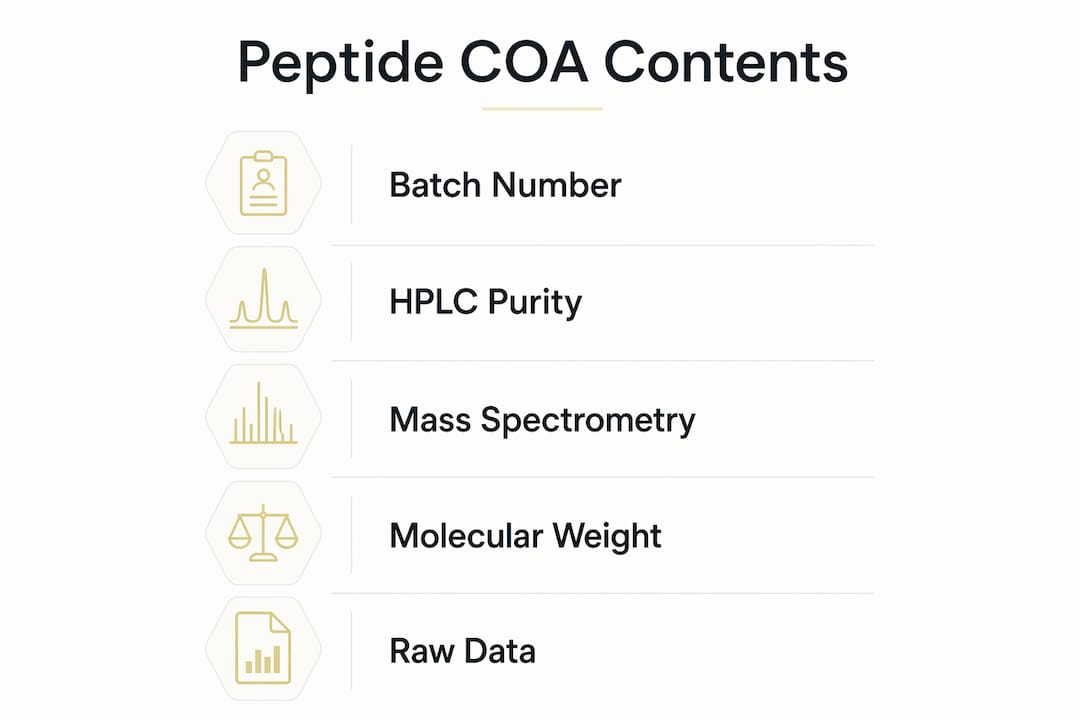
The mandatory elements of a trustworthy COA include:
- Supplier and testing lab name: Identifies who produced and who tested the compound. These should be separate entities for credibility.
- Batch or lot number: Ties the document to a specific production run. Generic COAs without batch numbers are marketing materials, not quality records.
- Test date: Confirms the analysis is current. Reports older than 12 months carry reduced reliability due to potential degradation.
- Test methods used: HPLC and LC-MS are the standard methods. A COA listing only one raises immediate questions.
- Retention time and chromatogram: The chromatogram is the visual fingerprint of the compound. Without it, the purity percentage is unverifiable.
- Purity percentage: Reported as a percentage of integrated peak area by UV absorbance. Legitimate COAs typically report purity between 95–99%.
- Analyst signature: Confirms a qualified person reviewed and approved the data. Its absence is a red flag, not a minor oversight.
| COA Element | Why It Matters |
|---|---|
| Batch number | Enables traceability to a specific production run |
| HPLC chromatogram | Provides visual proof of purity, not just a number |
| MS identity data | Confirms the compound is what the label claims |
| Analyst signature | Establishes accountability for the reported data |
| Test date | Confirms the analysis reflects the current batch condition |
Pro Tip: Request the raw chromatogram file, not just a screenshot. Authentic labs can provide the original data file, which cannot be easily fabricated.
How do you interpret peptide test results on a COA?
Reading a COA accurately requires understanding what each test actually measures and where each test falls short.
HPLC purity measures the proportion of UV-absorbing material that elutes at the expected retention time. A result of 98% means 98% of the UV-detectable signal belongs to the target compound. What it does not tell you is whether that compound is the correct peptide. HPLC purity is insufficient alone; a counterfeit peptide can achieve a high HPLC purity score while failing mass spectrometry identity tests entirely. That distinction matters enormously for research reproducibility.
Mass spectrometry closes the gap HPLC leaves open. MS confirms the molecular weight of the compound, which serves as a direct identity check. If the observed mass matches the theoretical mass of the target peptide within an acceptable tolerance, you have chemical identity confirmation. If it does not match, the batch is wrong regardless of how clean the HPLC trace looks.
Beyond purity and identity, two additional metrics deserve attention:
- Net peptide content (NPC): Purity percentages reflect UV-visible organic material only. They exclude water, salts, residual solvents, endotoxins, and heavy metals. NPC typically ranges from 70–90%, meaning the actual peptide mass per vial is lower than the labeled weight. Researchers who ignore NPC risk systematic underdosing in their experiments.
- Endotoxin levels: Critical for any in vivo or cell-based work. A peptide with excellent HPLC purity and correct MS identity can still compromise biological assays if endotoxin contamination is present.
Common misinterpretations to avoid:
- A single sharp HPLC peak does not confirm identity. It confirms homogeneity.
- A purity of 99% does not mean 99% of the vial mass is active peptide. NPC corrects for that.
- Retention time alone cannot distinguish between structural isomers. MS is required for that level of discrimination.
Pro Tip: Cross-reference the reported molecular weight on the COA against the theoretical mass calculated from the amino acid sequence. Free tools like the Peptide Molecular Weight Calculator make this a 30-second check.
What are the red flags of counterfeit or incomplete COAs?
Fabricated and generic COAs are a documented problem in the gray-market peptide segment. Up to 50% of peptides from unverified online vendors fail at least one quality metric. That figure reflects how widespread the problem is, not an edge case.
The most common red flags researchers encounter include:
- A COA with no batch number, meaning it cannot be tied to a specific production run
- Missing analyst signature or lab accreditation details
- No chromatogram image or raw data file, only a purity percentage
- A test date that is absent, vague, or suspiciously old
- HPLC data present but no MS identity confirmation
- A single COA applied to multiple products or batch sizes
In-house testing without third-party verification deserves particular skepticism. A vendor testing its own product and reporting its own results has an obvious conflict of interest. The document produced is not independent evidence. It is a vendor claim formatted to look like a quality record.
"A COA missing either HPLC or MS tests raises significant quality concerns. Both are the minimum standard for serious peptide research. A vendor's inability to provide both should be treated as a disqualifying factor, not a minor gap to overlook."
Recent market enforcement actions in 2026 confirm the stakes. Vendors with persistent batch failures detected by independent labs have faced shutdowns. Researchers who relied solely on vendor-supplied documentation had no warning before those failures affected their work.
How do you verify peptide COA authenticity in practice?
Verification goes beyond reading the document. It requires checking the source of the data independently.
-
Confirm lab accreditation. ISO/IEC 17025 is the international standard for testing laboratory competence. Check the accrediting body's public registry directly. Do not accept a vendor's claim of accreditation without verifying it yourself.
-
Look for a batch-specific COA URL. Public batch-specific COA lookup systems hosted by the testing lab shift the burden of proof away from the vendor. If the COA lives on the vendor's website as a PDF, it is easier to fabricate than a report hosted on the lab's own platform.
-
Cross-check the lab's contact information. Call or email the testing lab listed on the COA. Ask them to confirm the batch number and test date. Legitimate labs will confirm this. Labs that do not exist or do not recognize the batch number tell you everything you need to know.
-
Request independent third-party testing for critical samples. Researchers should send critical samples for independent testing even when a legitimate COA is supplied. For high-stakes experiments, the cost of a third-party test is negligible compared to the cost of failed or irreproducible results.
-
Prioritize immutable web-based reports over vendor PDFs. Vendor PDFs can be fabricated; web-based lab reports hosted by accredited labs and linked to a specific batch record are the current industry gold standard. Labs like Janoshik Analytical provide publicly accessible, batch-specific reports that researchers can verify directly.
Pro Tip: Save the verification URL for every batch you purchase. If a vendor later removes or changes the COA, your saved link to the lab's own platform preserves the original record.
Public accredited verification platforms significantly increase transparency and reduce the risk of working with substandard material. The strongest trust signal a vendor can offer is a live, batch-specific COA link hosted by an ISO/IEC 17025 accredited lab.
Key Takeaways
A peptide COA is only as reliable as the lab that produced it, the testing methods it documents, and your ability to verify both independently.
| Point | Details |
|---|---|
| COA minimum standard | Every COA must include HPLC purity, MS identity, batch number, and analyst signature. |
| HPLC alone is not enough | Mass spectrometry is required to confirm the compound's identity, not just its purity. |
| NPC affects dosing accuracy | Net peptide content typically runs 70–90%, meaning labeled weight overstates active peptide mass. |
| Batch-specific COA URLs | Lab-hosted, batch-specific COA links are harder to fabricate than vendor-supplied PDFs. |
| Independent testing is non-negotiable | Send critical samples to a third-party lab regardless of what the vendor's COA shows. |
Why I think vendor COAs alone are a liability in 2026
The peptide research community has spent years debating sourcing quality, but the conversation still centers too heavily on purity percentages and not enough on verification infrastructure. A number on a PDF proves nothing without the ability to trace it back to an accredited lab and a specific batch record.
What I have seen shift in 2026 is the expectation around transparency. Researchers who once accepted a vendor PDF as sufficient are now asking for live lab URLs, accreditation certificates, and the ability to independently confirm batch data. That shift is the right one. The vendors who cannot meet that standard are not hiding a minor gap in their process. They are hiding a fundamental quality problem.
The uncomfortable truth is that independent testing is not a backup plan for when you suspect a problem. It is the baseline practice for any experiment where reproducibility matters. The cost of a third-party test is a rounding error compared to the cost of publishing results built on a compromised compound.
My practical advice: treat every new vendor as unverified until you have confirmed their lab accreditation independently and received at least one batch-specific COA from a publicly accessible lab platform. Do not let a polished website or a well-formatted PDF substitute for that verification.
— Johan
Sslabsresearch and transparent peptide quality documentation
Researchers who have spent time chasing down COA verification know how rare genuine transparency is in this space. Sslabsresearch addresses that gap directly.

Sslabsresearch provides batch-specific COAs backed by independent lab testing, with purity confirmed at over 99% for its peptide catalog. Every batch is tied to a traceable record, and the company's partnerships with ISO-accredited labs mean the documentation reflects real, verifiable analytical data rather than vendor claims. For researchers who need reliable materials without the verification guesswork, the Sslabsresearch storefront offers an extensive, well-cataloged peptide range with transparent order tracking and tiered pricing for bulk orders. Quality documentation is not an afterthought here. It is built into the sourcing process.
FAQ
What is a peptide COA and why does it matter?
A peptide COA is a Certificate of Analysis that documents the identity, purity, and testing methods for a specific peptide batch. Without it, researchers have no verified basis for trusting the compound's quality or interpreting experimental results.
What tests must a COA include to be credible?
A credible COA must include both HPLC purity data and mass spectrometry identity confirmation. A COA missing either test fails the minimum standard for serious peptide research.
How do you check peptide purity at home or independently?
Researchers can send samples to independent third-party labs for HPLC and MS analysis. For a quick identity check, cross-reference the COA's reported molecular weight against the theoretical mass calculated from the peptide's amino acid sequence.
What does net peptide content mean on a COA?
Net peptide content reflects the actual mass of active peptide in a vial after accounting for water, salts, and other non-peptide material. NPC typically ranges from 70–90%, meaning the labeled weight overstates the true peptide quantity.
How do you spot a fake or unreliable COA?
Key red flags include a missing batch number, no analyst signature, absent chromatogram data, and HPLC results without MS identity confirmation. Any COA that cannot be traced to a publicly accessible, accredited lab report warrants serious skepticism.