
Experimental chemicals are substances formulated specifically for scientific investigation, characterized by defined purity grades and controlled applications in academic and industrial laboratories. The term covers everything from analytical reagents and biochemical buffers to synthetic compounds used in drug discovery and materials science. Purity standards such as ACS (American Chemical Society), USP (United States Pharmacopeia), and ISO (International Organization for Standardization) determine which grade suits which application. Sourcing from documented, reliable suppliers is not optional. It directly determines whether your data holds up under scrutiny.
What classifications and purity grades define experimental chemicals?
Laboratory reagents are categorized by purity grades that define their suitability for everything from routine cleaning to high-precision quantitative analysis. Understanding these grades is the first step toward choosing the right material for your work.
ACS, USP, and ISO grades explained
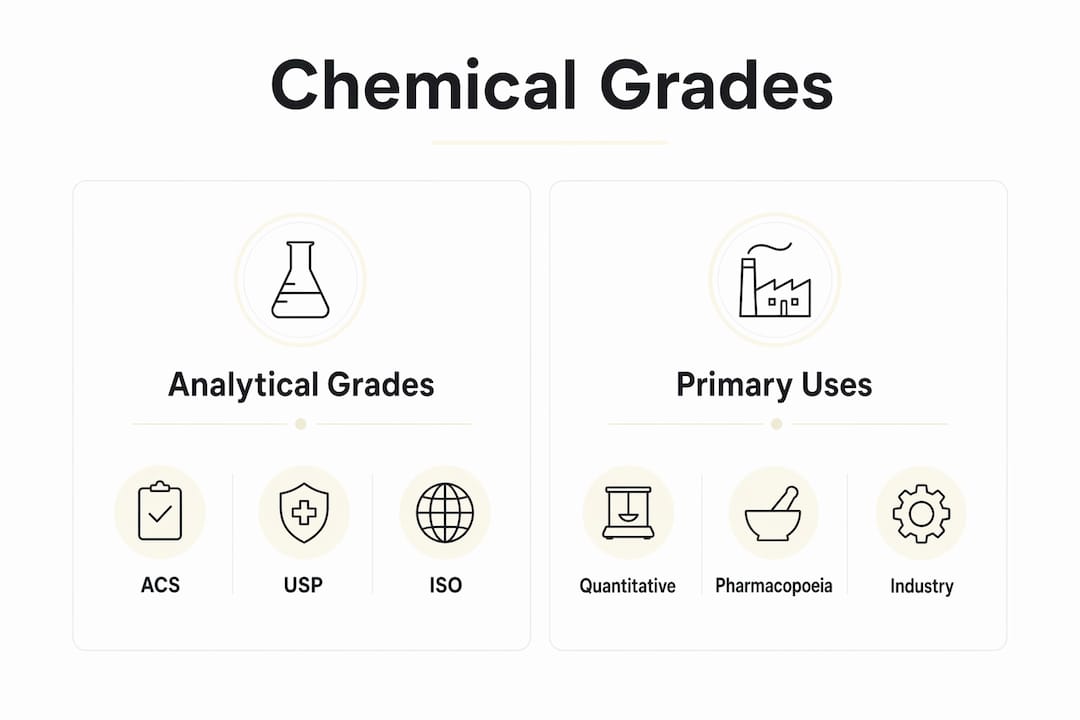
ACS grade meets the standards set by the American Chemical Society. It is the benchmark for analytical chemistry work where impurity levels must stay below defined thresholds. USP grade follows United States Pharmacopeia specifications and is required for pharmaceutical research and any work that may touch human or animal subjects. ISO grade aligns with International Organization for Standardization criteria, making it the standard for internationally reproducible results.

The practical difference between these grades is not just chemical purity. It is experimental reproducibility. A reagent that passes ACS specification for one lab will produce the same baseline results in another lab running the same protocol. That consistency is what makes multi-site studies and published findings defensible.
Below is a quick reference for the three primary grades:
| Grade | Governing body | Primary use case |
|---|---|---|
| ACS | American Chemical Society | Quantitative and analytical chemistry |
| USP | United States Pharmacopeia | Pharmaceutical and biomedical research |
| ISO | International Organization for Standardization | Internationally standardized workflows |
Routine laboratory reagents sit below these grades. They are acceptable for general cleaning, equipment rinsing, and non-critical preparatory steps. Using them in quantitative assays introduces uncontrolled variables. That is a mistake that shows up in your data long before you realize the source.
Key distinctions between reagent tiers:
- Analytical reagent (AR) grade: High purity, suitable for most quantitative experiments
- Laboratory reagent (LR) grade: Lower purity, appropriate for general-purpose tasks only
- HPLC grade solvents: Specifically purified to minimize UV-absorbing impurities for chromatography
- Trace metal basis grade: Certified for ultra-low metal content, used in ICP-MS and environmental analysis
How do experimental chemicals differ from illicit "research chemicals"?
The term "research chemicals" carries two distinct meanings: legitimate scientific use in regulated laboratory settings, and illicit New Psychoactive Substances (NPS) sold to evade drug laws. Conflating the two creates legal, safety, and reputational risk for working scientists.
Illicit research chemicals, also called designer drugs, are often untested and unregulated, unlike scientific-grade chemicals subject to EPA and industry standards. Manufacturers label them "not for human consumption" specifically to sidestep controlled substance regulations. The chemical structures mimic scheduled drugs but differ just enough to avoid classification. That gap closes quickly as regulators update schedules, but the health risks remain.
Legitimate experimental chemicals used in academic and industrial research operate under a completely different framework:
- They carry documented purity certificates and lot numbers
- They are sourced from suppliers who comply with EPA, FDA, and ISO regulatory requirements
- They come with Safety Data Sheets (SDS) that detail handling, storage, and disposal
- They are subject to batch testing and traceability from synthesis to delivery
The EPA's New Approach Methods (NAMs) Work Plan supports chemical evaluations focused on risk-based decisions to protect human health. This initiative promotes computational toxicology and alternatives to vertebrate testing. It represents the regulatory direction that legitimate chemical research is moving toward, and it has no overlap with the unregulated NPS market.
Pro Tip: If a supplier cannot provide a certificate of analysis (CoA) with lot-specific purity data, treat that as a disqualifying factor. No documentation means no accountability, and no accountability means no reproducibility.
What are the practical applications of experimental chemicals in research?
Chemical reagents facilitate detection, quantification, and visualization across pathology, microbiology, and molecular biology through standardized compounds. The range of applications is wide, but the underlying requirement is always the same: the chemical must behave predictably under defined conditions.
Here are the primary application areas where experimental chemicals drive research outcomes:
-
Pharmaceutical research: Synthetic compounds serve as lead candidates, reference standards, and metabolite analogs. Enzyme activity assays use highly purified substrates and cofactors to measure inhibition kinetics. Purity at this stage directly affects IC50 values and downstream drug development decisions.
-
Molecular biology: Buffers, restriction enzymes, and staining reagents are the backbone of PCR, gel electrophoresis, and Western blotting. Buffers, enzymes, and stains are vital to complex biological reactions and analyses in research and diagnostics.
-
Materials science and polymer synthesis: Monomers, initiators, and crosslinkers must meet tight purity specifications. A single impurity at the parts-per-million level can alter polymer chain length, mechanical properties, and thermal stability.
-
Toxicology testing: Reference standards for known toxicants allow researchers to calibrate detection methods and establish dose-response relationships. These standards must match certified reference materials to produce legally defensible data.
-
Environmental analysis: Common laboratory chemicals such as ethanol, acetone, buffers, and analytical reagent grade acids are standardized to international criteria. They enable consistent workflows in water quality testing, soil analysis, and atmospheric chemistry.
Batch consistency matters as much as purity grade in applied research. A pharmaceutical team running a 12-month stability study cannot switch reagent lots mid-study without re-validating the entire assay. That re-validation costs time and money that most project timelines cannot absorb.
What best practices ensure safety and quality control for experimental chemicals?
Trace contamination and degradation from improper storage undermine accuracy. Strict cold-chain management and storage protocols prevent compromised results. This is not a theoretical concern. It is the most common source of unexplained assay variability in active research labs.
Storage and handling protocols
Proper cold-chain handling and protection from light exposure for sensitive biochemical reagents preserve enzymatic activity and prevent degradation. Antibodies, enzymes, and fluorescent dyes degrade faster at room temperature than most researchers expect. Aliquoting stock solutions into single-use volumes prevents repeated freeze-thaw cycles that accelerate breakdown.
Storage requirements by chemical class:
- Enzymes and proteins: Store at -20°C or -80°C; avoid repeated freeze-thaw cycles
- Light-sensitive reagents: Use amber vials or foil wrapping; minimize bench exposure time
- Volatile solvents: Store in ventilated, flammable-rated cabinets away from ignition sources
- Hygroscopic compounds: Seal tightly and store with desiccant; weigh quickly to minimize moisture uptake
Documentation and lot tracking
Switching reagent lots without re-validation can cause irreproducible assay results and loss of scientific rigor. Maintaining updated SDS and lot number tracking is the minimum standard for any lab producing publishable data. Every reagent in an active experiment should have its lot number recorded in the lab notebook or electronic lab notebook (ELN) at the time of use.
Procurement should focus on supplier reliability and documentation over price. A reagent that costs 20% less but arrives without a CoA or with inconsistent lot documentation will cost far more in failed experiments and wasted time.
Pro Tip: Build a critical reagents register for every active project. List the reagent name, supplier, lot number, expiration date, and storage location. Update it every time a new lot enters the lab. This single habit prevents the majority of reproducibility failures.
Key Takeaways
Experimental chemicals require defined purity grades, documented sourcing, and strict storage protocols to produce reliable, reproducible scientific results.
| Point | Details |
|---|---|
| Purity grades determine application fit | ACS, USP, and ISO grades each serve distinct research contexts; using the wrong grade introduces uncontrolled variables. |
| Legitimate vs. illicit "research chemicals" | Scientific experimental chemicals carry full documentation and regulatory compliance; illicit NPS do not. |
| Applications span multiple disciplines | Pharmaceutical, molecular biology, materials science, and environmental research all depend on standardized reagents. |
| Lot tracking prevents reproducibility failures | Recording lot numbers at the time of use and re-validating after lot changes protects data integrity. |
| Supplier documentation is non-negotiable | A certificate of analysis and SDS are minimum requirements; price should never override documentation quality. |
What I've learned about reagent quality after years in the lab
The single most underestimated variable in experimental design is reagent sourcing. Researchers spend weeks optimizing protocols and hours troubleshooting instruments, but they often accept whatever chemical arrives in the cheapest catalog order. That asymmetry is where data quality quietly erodes.
I have watched entire datasets become unpublishable because a lab switched buffer lots mid-experiment without re-running validation controls. The assay looked fine. The numbers were internally consistent. But when the reviewers asked for lot-specific documentation, the lab could not produce it. The paper was rejected on reproducibility grounds, not scientific merit.
The supply chain problem is real and getting worse. Global disruptions have made consistent reagent availability harder to guarantee. The labs that handle this best maintain a 60-day buffer stock of critical reagents and pre-qualify at least two suppliers for each key material. That is not excess caution. That is project management.
Reagent stability under specified storage conditions is paramount to prevent compounding errors in sensitive clinical assays. The researchers who understand this treat their freezer logs with the same rigor they apply to their raw data. The ones who do not spend a lot of time wondering why their results do not replicate.
— Johan
How Sslabsresearch supports your research supply needs
Sourcing high-quality experimental chemicals from a supplier who understands research workflows makes a measurable difference in project outcomes. Sslabsresearch provides premium research chemicals, including peptides verified at over 99% purity through independent lab testing, with full documentation for every order.
The Sslabsresearch catalog covers an extensive range of research chemicals with transparent lot tracking, certificates of analysis, and tiered bulk pricing for labs managing larger procurement volumes. Secure transactions and discreet shipping make Sslabsresearch a practical choice for both individual researchers and institutional teams. If your project depends on consistent, documented reagent supply, the Sslabsresearch storefront is worth reviewing before your next procurement cycle.
FAQ
What are experimental chemicals used for in research?
Experimental chemicals are used in pharmaceutical development, molecular biology, materials science, toxicology testing, and environmental analysis. They provide the standardized reagents needed to generate reproducible, defensible scientific data.
What is the difference between ACS and USP grade chemicals?
ACS grade meets American Chemical Society standards for analytical chemistry. USP grade follows United States Pharmacopeia specifications and is required for pharmaceutical and biomedical research involving human or animal subjects.
Why does reagent lot tracking matter for reproducibility?
Switching reagent lots without re-validation can cause irreproducible assay results. Recording lot numbers at the time of use and re-validating after any lot change protects the integrity of your experimental data.
How should light-sensitive reagents be stored?
Light-sensitive reagents should be stored in amber vials or wrapped in foil, kept at the manufacturer's specified temperature, and minimized in bench exposure time to prevent photodegradation.
What distinguishes legitimate experimental chemicals from illicit research chemicals?
Legitimate experimental chemicals carry certificates of analysis, lot numbers, Safety Data Sheets, and full regulatory compliance. Illicit research chemicals, or New Psychoactive Substances, are untested, unregulated, and labeled "not for human consumption" to evade drug laws.